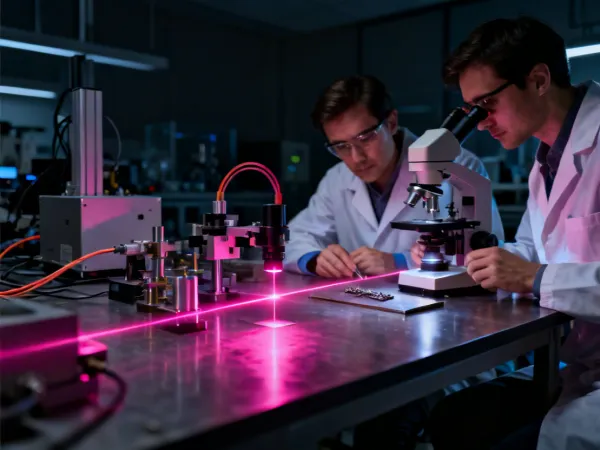
Where photonics science meets manufacturing reality. Our R&D lab bridges the gap between academic beam physics and the demands of production-floor welding, developing technologies that deliver measurable improvements in weld quality, consistency, and throughput.
The Laser Photonics R&D facility in Orlando, FL, houses 65 engineers and physicists working across three core disciplines: beam delivery optics, process monitoring systems, and weld metallurgy. The lab operates 14 laser systems ranging from 500W to 12kW, along with metallographic sample preparation, optical microscopy, and mechanical testing equipment.
Every customer project begins here. Before we ship a system, our applications engineers run physical test welds on your actual materials using your joint geometry. We document the parameters, capture cross-section images, and provide tensile or hardness data where applicable. This isn't a simulation or theoretical model; it's empirical data from your specific application.
This process typically requires 5–10 business days depending on material availability and the complexity of the joint configuration. For simple butt welds on common alloys, turnaround can be as fast as 3 business days.
Three proprietary developments that differentiate Laser Photonics systems from conventional fiber laser welding platforms.
Conventional fiber laser welding produces a narrow, deep keyhole that is inherently unstable at high travel speeds, leading to spattering and porosity. Our beam oscillation system dynamically adjusts the oscillation pattern (circular, figure-8, or linear) based on real-time feedback from the weld pool.
The practical result: gap-bridging capability up to 0.5mm without filler wire on butt joints, and documented porosity reduction of 60–80% versus static beam welding on zinc-coated steels. The system updates oscillation parameters at 10kHz, which is fast enough to respond to gap variations within a single weld pass.
Limitation: oscillation amplitude is currently limited to ±3mm. For wider gaps, filler wire feeding is required, which adds mechanical complexity to the weld head.
Our weld monitoring system captures optical emission spectra from the weld plume at 2,000 frames per second. By analyzing the spectral intensity ratios of specific elemental emission lines (primarily chromium, iron, and nickel for stainless steels), the system can detect compositional anomalies that indicate shielding gas coverage failure or filler wire feeding inconsistencies.
This is different from simple photodiode-based monitoring, which only measures total light intensity. Spectral analysis provides material-specific information. In validation testing at a customer's production facility, the system correctly flagged 94% of weld defects that were subsequently confirmed by destructive testing, with a false-positive rate of 3.2%.
Limitation: spectral monitoring is less effective on highly reflective materials (copper, gold) where the weld plume emission is weak relative to reflected laser light.
Fiber laser sources exhibit power fluctuations of 2–5% under normal operating conditions, which translate directly into weld penetration variability. Our closed-loop power regulation system measures actual delivered power at the workpiece (not at the laser source output) using a beam sampling optic, and adjusts the laser drive signal in real time to maintain ±0.5% power stability.
This matters most for thin-material welding where a 3% power increase can mean the difference between a good weld and a burn-through. On 0.5mm 304 stainless steel sheets, our customers report consistent penetration depth variation under ±0.05mm across 8-hour production shifts.
Limitation: the beam sampling optic absorbs approximately 0.3% of laser power. On a 6kW system this is 18W, which is negligible, but on low-power systems (<500W) it represents a measurable efficiency reduction.
From a founding question about bridging photonics science and production welding to a 280-person company serving 45 countries.
Laser Photonics was born from a question no one else was asking: what if industrial laser welding could be as precise as laboratory photonics? Our founding team of physicists and manufacturing engineers set out to bridge these two worlds.
Released our first handheld laser welding system with real-time weld monitoring, a combination that did not exist in the market at that time for portable units.
Developed proprietary adaptive beam oscillation technology that addressed the gap-bridging limitations inherent in conventional fiber laser welding. This became our key technical differentiator.
Expanded distribution network to 35+ countries across 4 continents, establishing regional service hubs to provide local technical support.
Launched the CleanTech laser surface preparation platform, extending our photonics expertise from welding into pre-weld cleaning and post-process surface treatment.
Inaugurated our 18,000 m² advanced manufacturing center in Orlando, consolidating laser source integration, system assembly, and applications testing under one roof.
We are transparent about whose components go into our systems because it matters for your maintenance planning and spare parts sourcing.
nLIGHT / IPG
Industrial fiber laser sources with >100,000 hour rated diode lifetime. We integrate sources from both manufacturers and select based on the specific power and beam quality requirements of each application.
Yaskawa
Servo drives and robot controllers for our automated welding cells. Yaskawa's Sigma-7 series provides the position repeatability (±0.01mm) needed for consistent weld start and end positions.
Beckhoff
EtherCAT-based industrial PC control with TwinCAT real-time software. Sub-millisecond cycle times enable our closed-loop power regulation and adaptive beam oscillation systems.
Proprietary Design
Our weld heads, including the beam sampling optic and oscillation mechanism, are designed and manufactured in-house at our Orlando facility. This is where most of our intellectual property resides.
Our applications engineering team thrives on problems that conventional welding cannot solve. Send us your material specifications and joint drawings for a no-obligation feasibility assessment.
Discover What's Possible